
About Islex
Built around a single insight about the β-cell
Islex Therapeutics is a precision biotechnology company developing islet-targeted therapies for diabetes with severe β-cell loss. We were founded on the observation that the protein making β-cells vulnerable may also be the route to reaching them.
Our position
Where the field goes wide, we go narrow
The islet is the site of disease
Type 1 diabetes damages a tissue that makes up a fraction of a percent of body mass. Therapies distributed throughout the body may deliver limited activity where it is actually needed.
Targeting changes the arithmetic
Concentrating activity at the islet is intended to raise local exposure while limiting systemic exposure. That is the question our preclinical program is built to answer.
A route, not just a drug
If an antibody reliably reaches β-cells, it may also be able to carry other payloads there. We are evaluating that possibility rather than asserting it.
The science
ZnT8: liability and opportunity
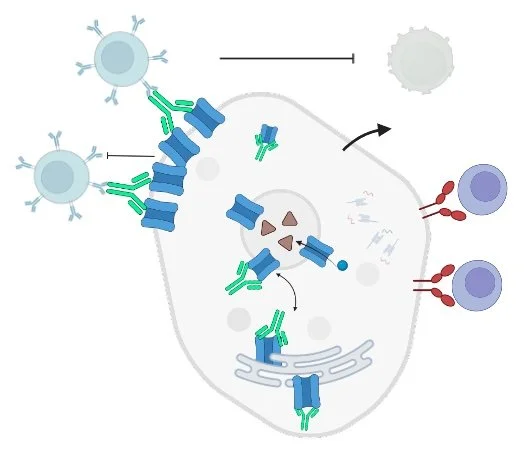
ZnT8 is a zinc transporter found primarily in pancreatic β-cells, where it plays a central role in insulin production, storage and secretion. Producing and folding it places real demand on the cell.
Under inflammatory stress, that demand contributes to strain on the endoplasmic reticulum. β-cells respond through the unfolded protein response. Sustained, that response can lead to increased antigen presentation and cell death, and ZnT8 itself is among the proteins against which people at risk of type 1 diabetes form autoantibodies.
ILX-101 is a humanized monoclonal antibody that binds ZnT8. In preclinical work, binding drives internalization of the antibody–protein complex, which is associated with reduced markers of β-cell stress.
What has been shown, and where
- Target specificity. ZnT8 expression is highly restricted to the pancreas at both RNA and protein level. Staining in mouse tissue and human islets shows binding to insulin-secreting β-cells.
- Internalization. Binding at the cell surface is followed by uptake and trafficking to the endoplasmic reticulum.
- Preclinical models. ILX-101 has been evaluated in NOD mice and in human islet models. Independent validation of the parent antibody was carried out across four laboratories at Johns Hopkins University.
All findings described are preclinical. ILX-101 has not been studied in humans.
Leadership
The people building it
Previously President and CEO of Carbon Biosciences, leading a parvovirus-based gene therapy platform. Before that, an early leader at Solid Biosciences, joining as its first employee and advancing to COO and CTO through the company’s IPO and platform scale-up. PhD in biological and biomedical sciences from Rutgers University, with postdoctoral training at Harvard.
Senior clinical research and development leader in endocrinology and type 1 diabetes, with more than 20 years in clinical endocrinology. Previously at Sanofi and Provention Bio, where she led cross-functional global teams advancing the first approved disease-modifying therapy for type 1 diabetes and secured nine global regulatory approvals.
Senior leader across analytical development, process development, quality control and manufacturing. Founded and built the protein biologics platform at Momenta Pharmaceuticals, work that contributed to the antibody therapeutic nipocalimab. PhD in pharmacology from Johns Hopkins University, with postdoctoral training at The Scripps Research Institute.
Development and regulatory strategist with over 15 years spanning discovery, DMPK, CMC, preclinical pharmacology, nonclinical, regulatory and early-phase clinical work. Has opened more than 40 INDs, IMPDs, CTAs and NDAs in the US, Europe and Australia. Managing Principal at Pharma Directions. PhD in biochemistry.
Working on the same problem?
We are interested in conversations with researchers, clinicians, potential development partners and investors focused on type 1 diabetes and targeted delivery.
ILX-101 and ILX-101-plus are investigational and have not been approved by the U.S. Food and Drug Administration or any other regulatory authority. Their safety and efficacy have not been established. Findings described on this site are from preclinical research and are not predictive of results in humans. This site is for general informational purposes and is not medical advice.